
Politics is coming to work this fall. You didn’t invite it, but it will arrive anyway. And when it does, employees across your company will look for signals that guide expectations for how they respond, react and behave.
Political tension changes what employees expect from one another. Among those who report feeling it at work, 36% expect colleagues to harm the company, from ignoring policies to leaking confidential information. Among those who don’t, only 10% expect those (and other) corrosive behaviors.
After six years of studying the American workforce with The Harris Poll, I have come to believe something most of my peers would argue with: silence about this election will cost your company more than taking action. I mean a specific kind of action, though. Our data points to decisions entirely within your control, and none necessarily require you to express a polarizing political opinion.
Your Employees Already Told You Where You Have Standing
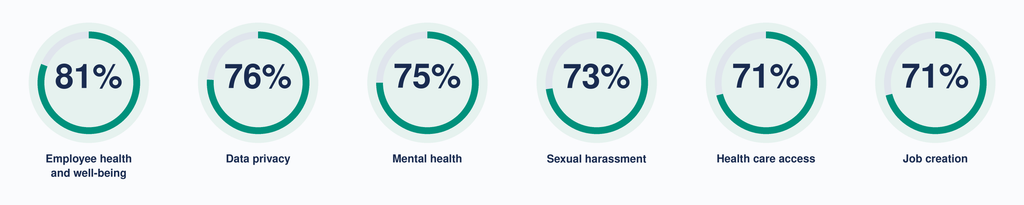
We enhanced our analysis this year by sorting societal issues into three tiers based on how strongly employees agree their organization should act. Six issues draw more than 70% agreement, and each one touches working life directly. Employee health and well-being leads at 81%, followed by data privacy at 76%, mental health at 75%, sexual harassment at 73%, and health care access and job creation at 71%.
Every issue on that list is a decision you already own. Your own leadership team sets the benefits. You approve the privacy practices. Your company funds the well-being investment, or leaves it fallow. None of it requires a statement, a stance or a press release. It requires a budget line and follow-through.
Where Employees Want Their Organization to Act
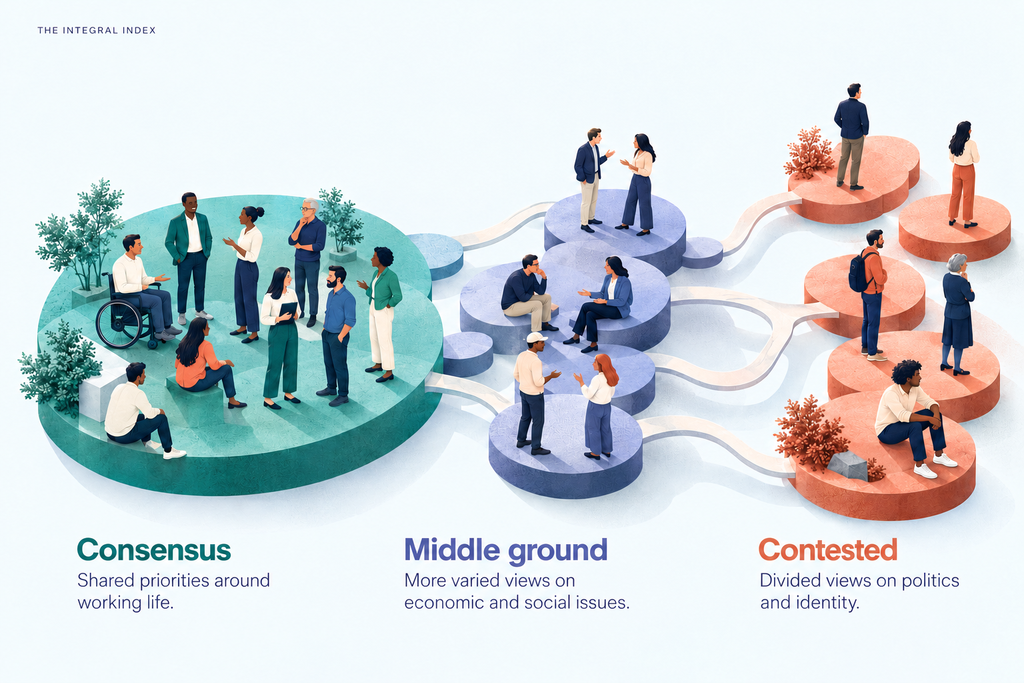
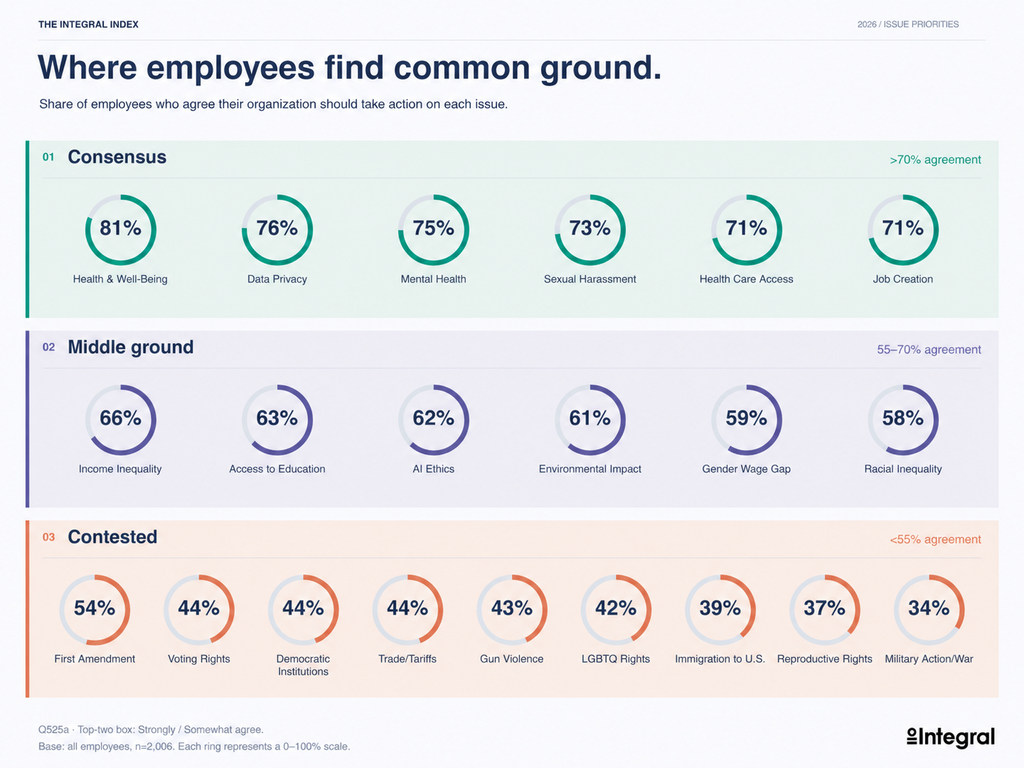
Issues tied to working life draw broad agreement. Economic and societal issues show meaningful but moderate disagreement. Issues tied to identity, politics or current events split the workforce sharply.
The issues consuming everyone’s worry sit somewhere else. First Amendment protections top the contested tier at 54% agreement, with voting rights at 44%, gun violence at 43%, immigration at 39% and reproductive rights at 37%. Employees are far less united on whether employers belong in these conversations. In between, economic and societal questions like income inequality at 66%, access to education at 63% and AI ethics at 62% draw solid support, with less certainty about how to act. The rest of this piece draws the line accordingly: act where your people have given you standing, and be deliberate where they haven’t.
Two more things worth knowing. Employees draw this line the same way regardless of party. Republicans, Democrats and Independents all land in the 70s and low 80s on mental health, sexual harassment and health care access. Even mental health issues, which some consider “coded left,” enjoy both support across the political spectrum and an impressive bearing on financial results, as AXIS Capital’s CEO Vincent Tizzio recently shared.
We’ve asked this question in each of the six years we have run the Index. The issues at the top of that list have barely moved.
Tension You Ignore Shows Up in Behavior
Somebody in your company is telling a talented friend at a conference this fall to look somewhere else for a job. Warning away candidates is one of several corrosive behaviors we measured, along with sabotage, leaked information and quiet shortcuts around policy. Employees who feel political tension at work expect to see these behaviors from colleagues at nearly four times the rate of everyone else. Six in 10 of them end the day emotionally drained, compared with three in 10 among employees who feel no such tension.
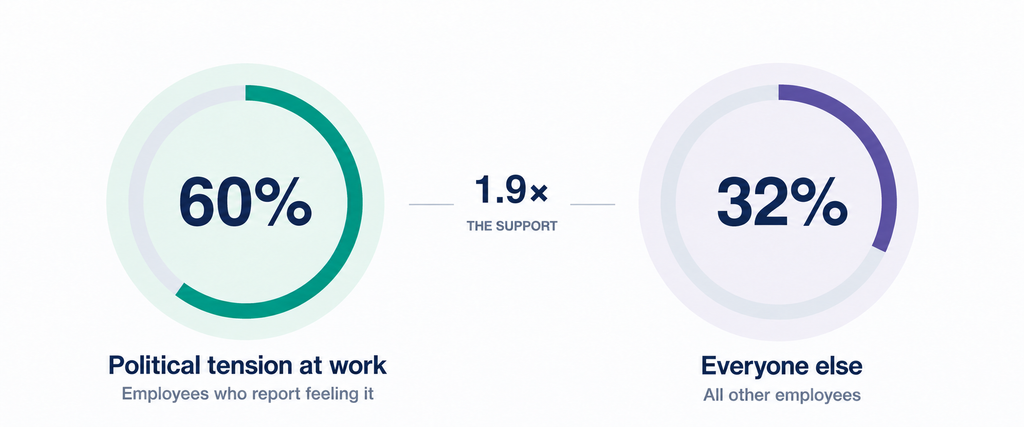
The data revealed something I did not expect. People living with workplace political tension want their employer to be more engaged. Across the contested issues, employees who feel political tension at work favor organizational action at an average of 60%, against 32% among everyone else. Roughly double, on exactly the questions we assume they want us to avoid.
The obvious objection holds. Someone attuned enough to notice tension in the break room probably cares about the issues in the first place, so the causation runs both ways. The employees most bothered by what is happening at work are the ones asking you to engage with it.
Voting Is the Easiest Decision on Your Desk
Voting rights sit in our contested tier at 44%, second only to First Amendment protections. Even the question of who gets to vote reads as partisan to a large share of the workforce, and I doubt anyone finds that surprising.
The policies are a different matter. Paid time off to vote is an administrative decision. So is paid time off to serve as an election worker. Both make it easier for your people to participate in something we all claim to value, and neither one endorses a candidate, a party or a position. Being pro-democracy is a winning bet no matter who holds office, and these two policies are how you place it without saying a word about the ballot.
At Integral, we signed the Civic Alliance Coalition for Democracy pledge and made both of those changes. I did it because supporting the right of the people who work for me to vote strikes me as the least I owe them as fellow citizens of a democratic society.
There is a split inside this finding you should see. Managers want their organization to act on voting rights at 52%, against 30% of non-managers. The people running your company lean toward action more than the people working in it, which means whichever way you go, part of your organization will read the decision as the wrong one. Make it deliberately.
What to Do Between Now and November
Four things, in this order.
Fund one consensus issue you have been deferring. Pick from the list above, put money and demonstrable executive attention behind it and tell your people plainly what you did and why. This is the highest-return move available to you, and it requires no position on anything particularly polarizing.
Add the two voting policies. Paid time off to vote, paid time off to work the polls. An afternoon of legal review and a line in the handbook.
Prepare your managers. They will field every question you decline to answer, and the week of the election is too late to start.
Do not let the autumn window for action get eaten by a debate over the wording of a statement. We never measured what statements do, and every finding above points at something else entirely: money, policy and preparation. Those are the things we can show move behavior.
Whatever gets settled in your executive suite arrives somewhere else entirely. It arrives in a team meeting, on a production floor, in a Slack channel at 4:45 on a Thursday, through first-line supervisors and managers who did not write the policy and will be asked to explain it anyway. One note on timing. We fielded this survey in February, months before campaign season heated up. Whatever these numbers describe, October will only heighten them.
Culture Shows Up When the Stakes Are High
Your employees are watching how you handle the hard stuff. They always have been. This fall they will have plenty to watch as your policies and politics take center stage, whether you like it or not.